Northern Cape Adjustment Budget: R100 million to fix failures flagged in Health Ombud report
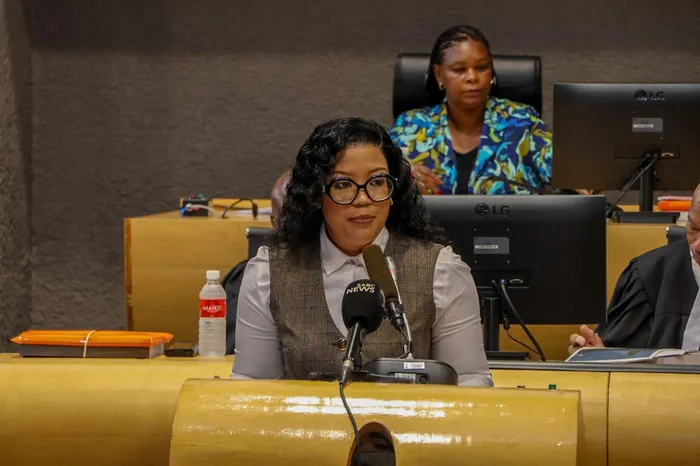
The MEC for Finance, Economic Development and Tourism, Venus Blennies-Magage.
Image: Facebook
THE MEC for Finance, Economic Affairs and Tourism, Venus Blennies-Magage, said that R100 million would be allocated to the provincial Department of Health to respond to the recommendations of the Health Ombud’s damning report into the death and neglect of psychiatric patients at Northern Cape facilities.
The Health Ombud, in collaboration with the South African Human Rights Commission, identified “poor governance and systemic lack of leadership and poor management at all levels, emergency unpreparedness, crumbling infrastructure, poor pharmacy and medicine control management, shortage of staff, poor quality assurance management, non-compliance with patient record keeping and poor laundry services” at the Northern Cape Mental Health Hospital (NCMHH).
Delivering the 2025/26 Northern Cape Adjustment Budget, Blennies-Magage said a further R12 million would be directed towards the appointment of nurses and other clinical posts.
She added that R30 million would go towards maintenance and laundry services at Robert Mangaliso Sobukwe Hospital, R20 million towards maintenance at the NCMHH, with the remaining balance directed towards settling long-outstanding accounts.
She said the Minister of Finance would visit the province in January 2026 to gain a deeper understanding of the Northern Cape’s fiscal position, as well as the significant wage-bill pressures within the departments of Health and Education.
“The adjustment budget allocates resources to these two critical departments. Although additional funds have been received from the national government, the province has needed to supplement these allocations, especially for the Department of Health, in response to the recommendations of the Health Ombud’s report.”
Blennies-Magage indicated that the Department of Health would develop a two- to three-year plan to gradually increase resources for the NCMHH.
“This balanced approach, between paying off our debt as quickly as possible and addressing essential service delivery needs, is necessary to prevent further harm to the people of the Northern Cape.”
She noted that allocated finances were formulated on population density and did not adequately account for the large geographic size of the province.
“This significantly increases the cost of service delivery.”
Unemployment remains big challenge
Blennies-Magage said that with the unemployment rate standing at 31.2%, departments were urged to develop programmes to create sustainable jobs and ensure the success of the provincial Jobs Plan.
“The people of the Northern Cape expect solutions, and we must not let them down.”
She noted that community and social services employed the most people in the province, with more than 80,000 employees, followed by the trade sector with approximately 52,000 employees.
“Utilities remain the smallest sector, employing around 4,000 people. Between the second and third quarters of 2025, job losses occurred in community and social services, finance and trade, while all other industries recorded employment gains.”
Municipal finance concerns
Blennies-Magage advised that during the 2025/26 financial year, 19 municipalities had adopted unfunded budgets where revenue sources were not secured.
“This practice is risky and contravenes principles of sound financial management.”
She said Sol Plaatje Municipality qualified for its first debt write-off when Eskom wrote off one-third of its debt, valued at R248 million, on August 7.
“Similarly, Siyancuma Local Municipality qualified for its first debt write-off, with National Treasury instructing Eskom on August 14 to write off one-third of its debt, valued at R75.9 million.”
She said a water-board debt-relief initiative had been introduced to address escalating municipal debt owed to Water Boards (WBs), the Water Trading Entity (WTE) and Water User Associations (WUAs).
“Under this incentive, municipalities that settle all current invoices for 12 consecutive months will have one-third of their arrear debt written off by the Department of Water and Sanitation. To date, seven municipalities have been approved for this programme.
“However, debt relief is an extraordinary form of support that requires municipalities to enforce strict internal controls and cost-containment measures to remain compliant with monthly obligations.”
More funds to improve weak financial compliance
The MEC said Provincial Treasury had allocated a R10 million grant to assist municipalities in improving compliance across both financial and non-financial areas.
“This is in response to poor audit reports where the Auditor-General noted consistently weak municipal financial systems, inadequate fiscal discipline, weak financial planning, poor internal controls, and insufficient capacity, particularly in critical positions. These weaknesses result in unauthorised and irregular expenditure, revenue leakages from non-billing, infrastructure neglect, and persistent failures in service delivery.
“The AG attributes these systemic issues to poor management practices and a lack of consequence management.”
Early retirement dispensation
Blennies-Magage said Cabinet had approved early-retirement options without pension penalties and a voluntary exit programme for public service employees to help manage the wage bill.
“Financial incentives will be offered to participating employees based on their years of service. National Treasury will provide additional funding to departments implementing these measures, requiring that savings be directed toward alleviating wage-bill pressures or hiring new staff where necessary.”
She added that the application process for these programmes ran from October to September annually, with thousands of eligible employees identified within the Northern Cape provincial government.
2025/26 Adjustment Budget allocations
Adjustment budget total: R1 billion
Department of Education: R92 million
- R80 million set aside specifically for compensation-of-employees pressures.
Early Childhood Development (ECD): R39.8 million
- Subsidy increase from R17 to R24 per child for centre-based programmes.
- Non-centre-based programmes increase from R6 to R9 per child.
Department of Health: R267.5 million
- Includes R160 million in national funding for retaining health professionals, appointing medical doctors and addressing goods-and-services pressures.
Department of Sport, Arts and Culture: R15 million
- R3.2 million allocated for the national school sport championships.
Department of Roads and Public Works: R157.7 million
- R10 million for technical and finance personnel appointments.
- R95.6 million for settling rates and taxes bills for Sol Plaatje Municipality.
Department of Economic Development and Tourism: R15.8 million
- R3.6 million to support Small, Medium and Micro Enterprises.
- R3.3 million for the Diamonds & Dorings Kimberley Big Hole Marathon.
- R1.7 million for the Diamonds & Dorings Kimberley Diamond Cup.
Department of Co-operative Governance, Human Settlements and Traditional Affairs: R70 million
- To address bulk-infrastructure backlogs in Roodepan (Sol Plaatje) and in Emthanjeni Local Municipality.
- Collaboration with traditional communities: R11.2 million.
- Commission of Inquiry on Traditional Leadership in John Taolo Gaetsewe District: R6 million.
- Support for traditional leaders: R5 million.
- Compensation for employees in technical and critical positions: R23.5 million.
Office of the Premier:
- Settlement agreement with Transnet (IGR processes): R20 million.
- Skills development in the province: R5.1 million.
Northern Cape Provincial Legislature constitutional responsibilities: R70.2 million.
Provincial Treasury to provide support to municipalities: R10 million
Interest on the Development Bank of South Africa loan: R8.5 million
Department of Transport, Safety and Liaison: R46.7 million
- R13.2 million ring-fenced for lease costs.
- R24.9 million for the insourcing of 87 security personnel.