Northern Cape telescope peers billions of years into the past, revealing rare cosmic glow
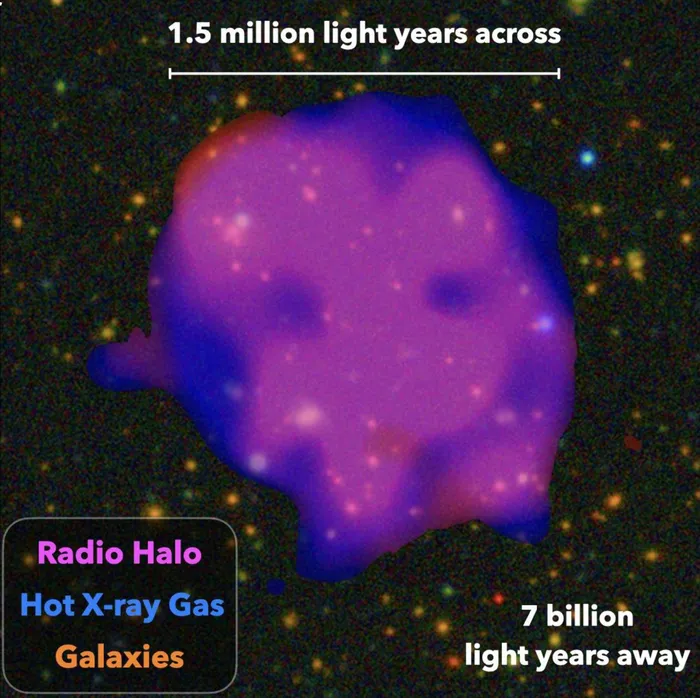
MeerKAT-discovered radio halo (pink) and hot X-ray gas (blue) between the galaxies (orange) that make up the massive galaxy cluster SPT-CLJ2337-5942.
Image: South African Radio Astronomy Observatory
FROM the radio-quiet Karoo flats outside the Northern Cape town of Carnarvon, South Africa’s world-class MeerKAT radio telescope has captured a whisper from the distant universe – a rare and extremely faint cosmic glow from a massive cluster of galaxies nearly seven billion light-years away, marking the most distant discovery of its kind ever recorded by scientists at the South African Radio Astronomy Observatory (SARAO).
Based at the remote Klerefontein site, the MeerKAT array operates in one of the quietest radio environments on Earth – a natural advantage that allows scientists to detect the faintest signals from deep space, including this newly discovered ultra-steep-spectrum radio halo glowing from a colossal galaxy cluster in the far reaches of the universe.
The rare signal was detected at the heart of a colossal galaxy cluster called SPT-CLJ2337−5942, a structure so vast that its mass is estimated to be roughly a quadrillion times greater than that of the Sun.
The breakthrough discovery was led by Isaac Magolego, a PhD student at University of the Witwatersrand, under the supervision of Professors Roger Deane and Kshitij Thorat from Wits and the University of Pretoria. The findings have been accepted for publication in the prestigious Monthly Notices of the Royal Astronomical Society: Letters.
Galaxy clusters are the largest objects in the universe held together by gravity, containing thousands of galaxies and vast clouds of super-heated gas. Radio halos form when extremely energetic particles are whipped through powerful magnetic fields – often triggered when massive clusters collide in violent cosmic mergers.
“At first, I thought this was a normal radio halo,” said Magolego. “But the detailed analysis revealed something far more unusual: the most distant ultra-steep-spectrum radio halo ever detected. It’s incredibly exciting, and I’m so grateful to SARAO for supporting my journey from undergraduate studies all the way to this discovery with MeerKAT in the final year of my PhD.”
Scientists say the unusual glow closely mirrors X-ray images of hot gas in the cluster, strengthening the link between turbulence, magnetic fields and high-energy particles – a relationship that becomes increasingly difficult to observe in the early universe due to the heat left behind by the Big Bang.
The discovery forms part of the international MeerKAT–South Pole Telescope (SPT) survey, which combines MeerKAT’s exceptional sensitivity with observations from the 10-metre South Pole Telescope located at the Amundsen-Scott South Pole Station in Antarctica.
“This result highlights MeerKAT’s remarkable ability to reveal new important astrophysical laboratories in the distant universe – a key driver of our survey design strategy”, said Professor Roger Deane, co-lead of the MeerKAT-SPT survey with Professor Joaquin Vieira of the University of Illinois Urbana-Champaign.
SARAO managing director Pontsho Maruping said the discovery reflects both scientific excellence and long-term investment in South African talent.
“This discovery highlights MeerKAT’s extraordinary sensitivity and the power of collaboration between SARAO, our universities, and global partners. It also reflects the impact of SARAO’s 20-year investment in human capital development, with Isaac’s achievement demonstrating the strength of our talent pipeline. As we enter the SKA era, MeerKAT continues to affirm South Africa’s leadership in cutting-edge radio astronomy.”
MeerKAT, operated by SARAO, continues to place South Africa at the forefront of global radio astronomy, and upcoming observations with both MeerKAT and the Square Kilometre Array Observatory (SKAO) are expected to deepen our understanding of how common – and how important – these rare cosmic halos are.
Magolego will continue his research as a SARAO postdoctoral fellow at the University of Pretoria in 2026, while the full scientific paper will soon be available to the global research community through the official MNRAS Letters platform.
The Northern Cape’s eyes on the universe, it seems, are only getting sharper.
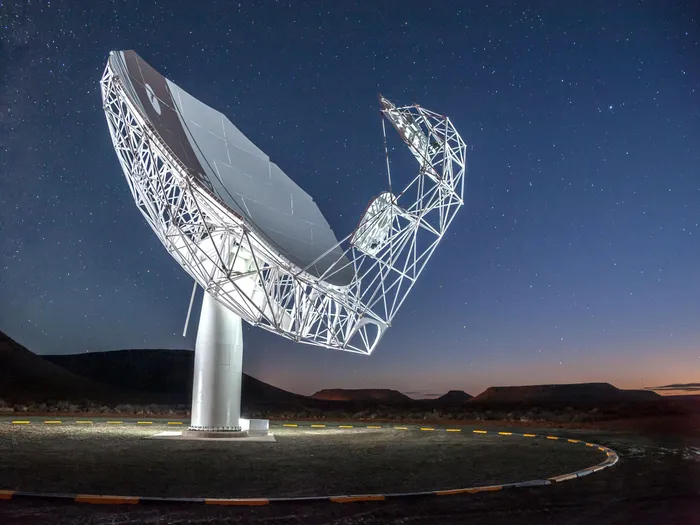
One of the 64 MeerKAT telescopes observing our skies.
Image: UWC