Revamped Renault Captur: French elegance meets compact SUV versatility
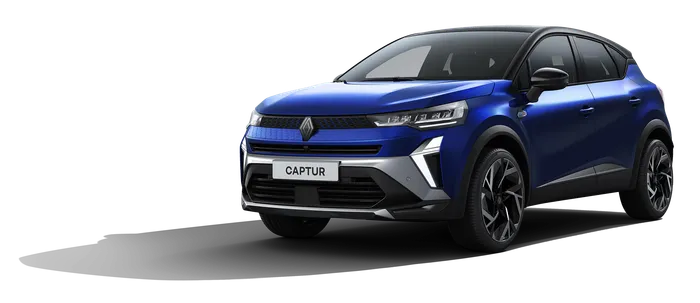
Renault has sharpened the Captur’s look with a cleaner front end that aligns it with the brand’s latest design language.
Image: Supplied
Renault has significantly upgraded its B-segment SUV, Captur, with a range of new interior, technology, and exterior changes as it continues to fight for relevance in an ever-increasing and cluttered part of the market.
First introduced in South Africa in 2015, the French “voiture à vivre” (car for living) has sold more than 12 000 units locally and an impressive 2 million globally.
It now has three variations, starting with the Techno, then the Iconic and the range-topping Esprit Alpine.
You may recall that Renault’s sport division used to have the RS (Renault Sport) nomenclature, which is now known as Alpine.
Exterior
Renault has sharpened the Captur’s look with a cleaner front end that aligns it with the brand’s latest design language. The grille is more intricate, the bonnet sits higher and flatter, and the overall effect is a strong, purposeful face.
There’s a new horizontal air intake above the splitter, another in the bumper, and additional air ducts near the daytime running lights to aid cooling and front brake ventilation.
All models now have LED headlights as standard, with the brand’s vertical, half-diamond daytime running light signature clearly visible. There’s also a new welcome light sequence when you unlock the car.
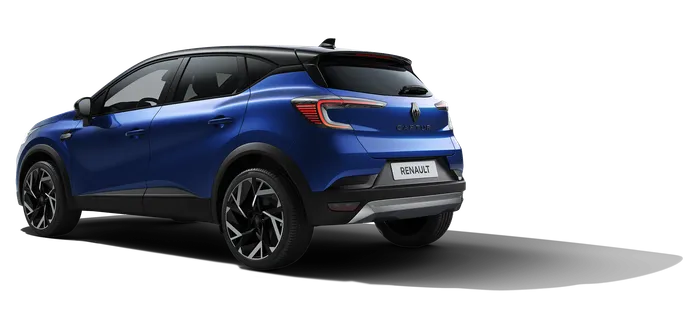
At the back, the transparent light housings expose the internal elements of the lamps, paired with a revised logo and a reshaped diffuser. The result is a cleaner, more modern finish.
Techno models ride on 17-inch alloys and feature matte black detailing along the lower body and beltline, along with chunky black skid plates. The Iconic model gets new 18-inch ‘Black Hole’ alloys and high-gloss black exterior trim.
At the top of the range, the Esprit Alpine stands out with ice black badging, gloss black window surrounds, distinctive 19-inch elixir wheels, and front and rear slate-grey skid plates for a more sporty appearance.
Colour choices include Arctic White, Flame Red, Iron Blue, Oyster Grey and a new Urban Grey.
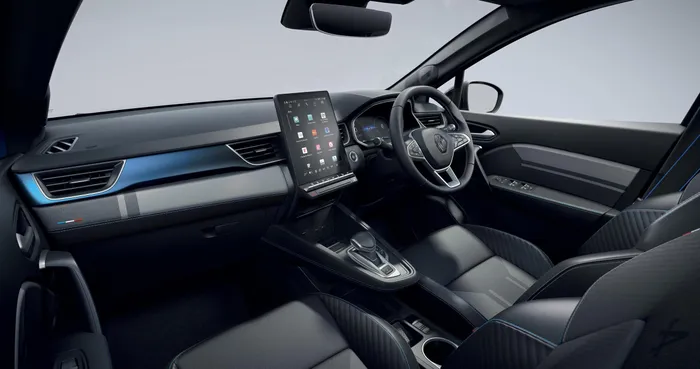
The Renault Captur is fitted with the new OpenR Link infotainment system that supports both Apple CarPlay and Android Auto.
Image: Supplied
Interior
Inside, the 10.4-inch touchscreen receives Renault’s new OpenR Link infotainment system that supports both Apple CarPlay and Android Auto.
I found the interface laid out logically, with clear menus, sharp graphics and quick responses.
Depending on the trim level, there are subtle Alpine-inspired details. These include contrast stitching on the seatbelts, aluminium sports pedals, branded door sills and a reshaped steering wheel that felt substantial.
Upholstery across the range makes use of recycled materials, including bio-sourced fabrics in Esprit Alpine models.
Rear knee room measures 221mm, helped by a sliding rear seat that can move through a range of 160mm, allowing you to prioritise either passenger space or boot capacity.
With the rear bench fully forward, luggage capacity grows to 616 litres. Fold the 60:40 rear seats and load length stretches to 1.57 metres, with a carrying capacity of 1,596 litres.
Engine and powertrain
Under the bonnet, the 1.3-litre four-cylinder turbo petrol engine remains unchanged, producing 113kW and 270 Nm of torque coupled to a six-speed efficient dual-clutch transmission (EDC) driving the front wheels.
Several driving modes are accessible on the steering wheel. Multi-sense, which is available on the Iconic trim level, includes four driving modes: Eco, Sport, Comfort and Perso.
The steering effort, engine response and agility of the chassis change accordingly for each mode, as does the colour of the ambient lighting and dashboard display.
Under the bonnet, the 1.3-litre four cylinder turbo petrol engine remains unchanged producing 113kW and 270 Nm of torque coupled to a six-speed efficient dual-clutch transmission (EDC).
Image: Supplied
Driving
We drove the Esprit Alpine model on launch, which included a loop from Krugersdorp around the Hartbeespoort dam with a combination of highway and North West Province unmaintained roads.
What struck me first was how solidly the Spanish-built Captur felt. The doors shut with a pleasant thud rather than a tinny sound we sometimes hear in the segment.
The interior also felt premium with soft touch surfaces, delicate stitching and comfortable seats that provided ample support.
There were three of us in the car, and with my seat set optimally for driving, there was enough space for the passenger behind me, the interior belying its B-segment status.
The suspension initially felt on the stiff side, but not uncomfortably so and once you get used to the car, it’s not at all noticeable. It does help on the twisty bits with minimal body roll, shown when a quick reaction was needed to avoid potholes.
It will cruise comfortably at the national speed limit, and we experienced virtually no engine or wind noise inside the cabin.
With the 1.3-litre turbo mill, it doesn’t have a rapid-fire getaway but rather a gentle pick-up of speed even in sport mode.
On an empty stretch of road, we engaged in some spirited driving, and when the revs were high, there was some protest from the engine, and there were one or two occasions that it would run out of steam on uphills.
I doubt very much, though, that an average owner would be doing that regularly, so as they say, it ticks all the boxes.
It’s a not-so-significant list that the Renault Captur competes against, including the VW T-Cross, Hyundai Creta, Peugeot 2008, Beijing X55 Plus, Mazda CX3, GAC Emzoom, Opel Crossland, VW Taigo and Haval Jolion.
How it will fare remains to be seen, but a little French flair has never done anyone any harm.
It comes with a five-year/150 000km mechanical warranty and a three-year/45 000km service plan.
Pricing (December 2025)
- Renault Captur 1.3L Techno EDC: R515 999.
- Renault Captur 1.3L Iconic EDC: R544 999.
- Renault Captur 1.3L Esprit Alpine EDC: R614 999.