From classroom to cash: The top TVET trades employers can’t stop hiring

Trades such as plumbing can be enriching.
Image: Freepik
With university fees rising and artisan shortages across South Africa, many learners could consider turning to TVET colleges for practical, job-ready skills.
And salaries can be anywhere from R7,000 to R30,000 depending on what trade you study and your level of qualification and experience.
South Africa aims to train tens of thousands more artisans each year to close skills gaps in key sectors such as manufacturing, construction and infrastructure development – though shortages persist.
TVET colleges in South Africa are significantly cheaper than universities. For many students, the National Student Financial Aid Scheme (NSFAS) can cover almost all study-related costs, including tuition, registration and living allowances.
Typical tuition fees (public TVET)
Public TVET tuition fees vary by college and programme, but students can generally expect:
- Electrician / plumbing / mechanical trades (annual tuition): • Electrician: around R13,000–R15,300 per year at many colleges • Plumber: around R13,000 per year • Millwright: around R17,000–R17,400 per year • Diesel mechanic / automotive: around R16,900 per phase/year, with several phases required to complete the programme • Welding / boilermaker: from roughly R15,000 up to R18,400 per phase/year
These figures are indicative annual fees for standard occupational programmes at public colleges – your exact cost depends on the campus, trade and whether you take the course in phases.
Below are five in-demand TVET trade qualifications, what subjects or entry requirements you’ll need, the core learning areas, and insights into why these skills are sought after in the labour market.
- Electrician
What you’ll learn: power system installation, wiring, control systems, testing and inspection. Typical entry: NCV Level 3 (Electrical Infrastructure) or N2–N6 Electrical Engineering with Electrical Trade Theory/Technology.
Key subjects: engineering maths, electrical trade theory, engineering science and related technical modules are part of preparatory N-courses that deepen understanding of electrical concepts.
Why it matters:
Electricians are essential across residential, commercial and industrial sectors. South African labour market research identifies electricians among the trades that employers struggle to fill, contributing to infrastructure bottlenecks and increasing demand from construction and energy sectors.
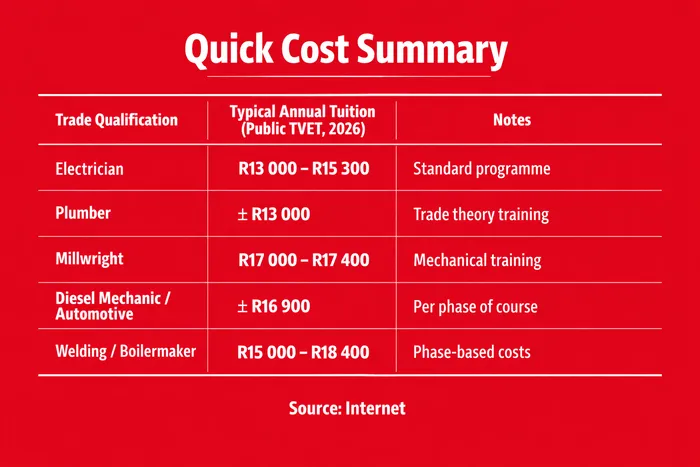
Indicative costs of trade qualifications.
Image: ChatGPT
- Automotive/Diesel Mechanic
What you’ll learn: engine diagnostics, transmission systems, vehicle maintenance, fault finding and repair.
Typical entry: NCV Level 3 (Engineering Related Design or mechanical streams) or N‑courses with Diesel or Motor Trade Theory.
Key subjects: mathematics, engineering science, mechanical drawing and theory relevant to automotive systems.
Why it matters:
South Africa’s automotive industry and transport sectors rely on skilled mechanics for fleet maintenance and diagnostics – skills that remain hard to source, especially for modern vehicle systems.
- Welder / Boilermaker
What you’ll learn: welding techniques (MIG, TIG, arc), metal fabrication, cutting and assembly.
Typical entry: NQF Level 1 with maths and science or NCV Level 3 with engineering related subjects for foundational understanding before progressing.
Key subjects: fabrication theory, structural steel drawings, engineering science and mathematics (especially at N1‑N3 levels where welding fundamentals are taught).
Why it matters:
Welders and boilermakers are critical in construction, manufacturing, pipelines and heavy industries. Market data consistently list welding and fabrication among scarce skills in the trades sector.
- Millwright / Mechanical Fitter
What you’ll learn: installation, maintenance and repair of industrial machinery and mechanical systems.
Typical entry: N2 certificate with engineering maths and trade theory or relevant NCV Level 3.
Key subjects: mechanical theory, fitting technology, electrical fundamentals and tools/equipment modules in millwright programmes.
Why it matters:
Industrial sectors, including mining and manufacturing, require technicians who can keep complex machinery running – a growing need as local production and mechanisation expand.
- Plumber
What you’ll learn: installation and maintenance of water supply, sanitation and drainage systems.
Typical entry: NCV Level 3 (Civil Engineering & Building Construction with plumbing subjects) or N‑courses covering plumbing trade theory.
Key subjects: civil technology, plumbing trade theory, math and science relevant to fluid systems.
Why it matters:
Plumbing skills are essential to housing, commercial building and municipal services – areas where demand remains steady and opportunities exist for both employment and self‑employment.
What you’ll actually study at TVET
TVET trade pathways typically combine three components:
- Theory: technical principles and conceptual knowledge (e.g., electrical systems theory, mechanical principles).
- Practical: hands‑on work in workshops and simulated industry environments.
- Work experience: structured workplace learning or apprenticeships where learners apply skills in real jobs.
Upon completing the training and workplace experience, learners undergo a trade test. This is a national assessment required to become a certified artisan and improve employability.
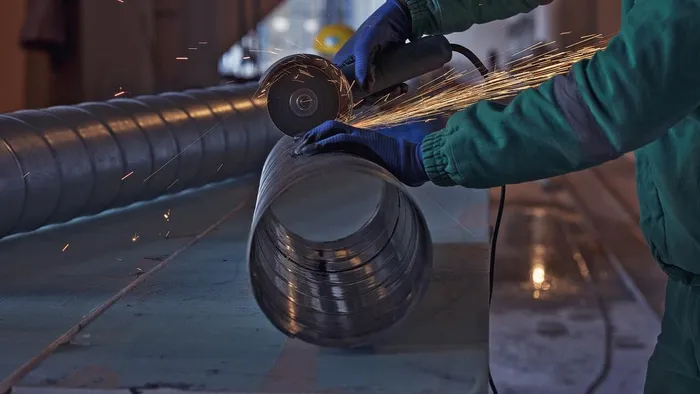
Trade skills are in high demand and could be a viable alternative to university.
Image: Freepik
Subjects and preparation
Most TVET trade tracks require a combination of Maths or Mathematical Literacy, Science and trade-related theory subjects.
These are often taught as part of NCV or N-course programmes before you progress to full occupational certificates.
For example, electrical and mechanical proposed curricula include engineering maths, industrial electronics or diesel trade theory in early levels to build a foundation before hands‑on learning.
Industry demand: what the data shows
According to government and labour market research, South Africa continues to face a shortage of qualified artisans despite efforts to increase training.
Trades such as electricians, millwrights, plumbers, welders and automotive technicians remain on national demand lists because many employers import skills to fill gaps.
Artisan earnings are also competitive compared with other pathways.
Some estimates suggest qualified artisans in skilled trades can see earnings well above entry-level salaries, with potential for self-employment or contract work after qualification.
IOL BUSINESS