Northern Cape telescope cracks cosmic code surrounding 'phoenix' star
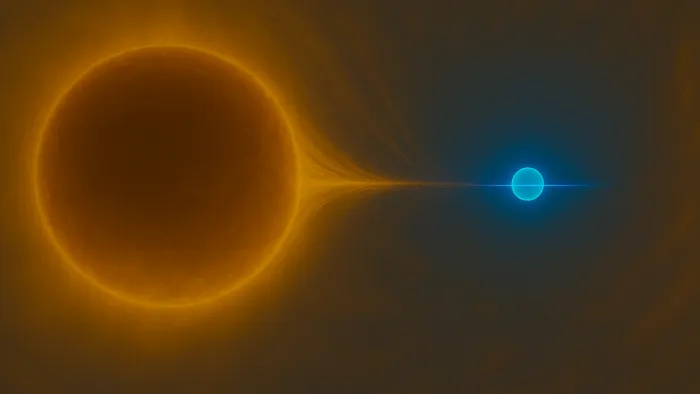
OH G64 is a system composed of a red supergiant (at left, in orange) and a smaller hot star (at right, in blue). New observations with SALT suggest that the hot star may be causing the atmosphere of the red supergiant to spread out. Some of it may fuel a disk of gas around the hot star, giving rise to emission lines in the SALT spectrum. This is an artist’s impression of what that may look like (not to scale).
Image: SAAO / Created by Jacco van Loon using Copilot
AN INTERNATIONAL team of astronomers has used the Southern African Large Telescope (SALT), located at the South African Astronomical Observatory complex at Sutherland in the Northern Cape, to unravel the mystery surrounding a massive star, WOH G64, in the Large Magellanic Cloud.
WOH G64 is one of the coolest, most luminous, and dustiest red supergiant stars known, and has been fading rapidly over the past decade. Initial observations suggested it might be transforming into a yellow hypergiant, a brief phase before a supernova explosion.
What is a supernova explosion?
A supernova explosion is like a massive, cosmic bomb. It's what happens when a star gets old, runs out of energy, and suddenly collapses. This collapse causes a huge explosion that's super bright and releases a ton of energy.
Supernovae can create heavy elements like gold and uranium, and even trigger the formation of new stars. They're also incredibly bright, allowing astronomers to study them from vast distances.
In the case of WOH G64, it's a red supergiant that's likely to end its life in a core-collapse supernova explosion, given its size and evolutionary stage.
'A phoenix rising from the ashes'
However, SALT's observations, made between November 2024 and December 2025, reveal that WOH G64 is still a red supergiant. The telescope detected molecular absorption bands from titanium oxide, indicating the star remains cool.
Astronomers believe the star's unusual behaviour is caused by its interaction with a smaller companion star. As the companion approaches, its gravity is stretching WOH G64's atmosphere, triggering mass loss and creating a new dust cloud.
Dr Jacco van Loon, lead researcher, says, "We're witnessing a 'phoenix' rising from the ashes. The red supergiant's atmosphere is being stretched, but not stripped away."
The findings suggest WOH G64 is still in its red supergiant phase, providing new insights into the life cycle of massive stars.