The unseen gambling epidemic: How South African women are affected
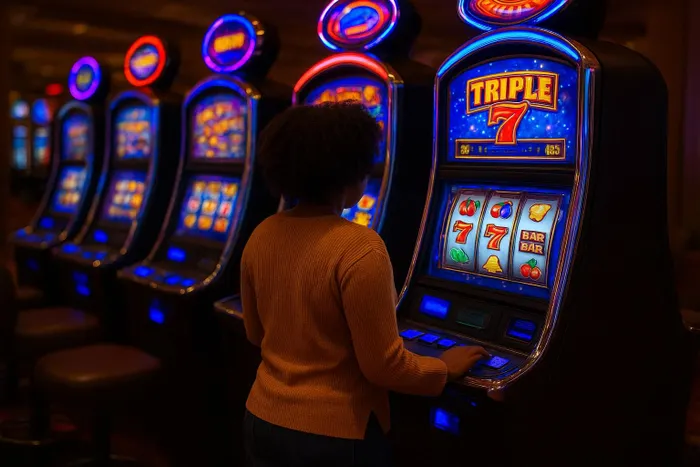
What begins as entertainment or distraction can quickly turn into a lonely, isolating addiction.
Image: Gerry Cupido / Gemini
I walk into my local casino just after 10 am on a Wednesday, curious about the world that draws in so many women.
A woman in a peak cap rushes past me, head lowered and clutching her handbag.
It becomes clear immediately that hope and disappointment live close together here.
Most of the people seated at the slot machines are women, staring blankly at flashing lights that promise excitement but often deliver the opposite.
With R50 in my pocket, I decide to try my luck. A staff member tells me, “This is your lucky day. There’s always beginner’s luck.”
The thrill of the first win comes quickly, but so does the loss.
Within minutes, my R50 is gone, and I leave feeling deflated. It is a tiny glimpse into a cycle that has consumed the lives of countless South African women.
A growing problem in South Africa
Gambling is becoming a serious concern in South Africa, extending from casinos to online platforms and mobile apps.
This shift exposes more women to addictive behaviour at a time when many are already dealing with financial strain, emotional pressure or social judgment.
A study in Frontiers in Psychology notes: “Female gamblers are branded as negligent, vicious, and bad mothers during the gambling spiral, generating feelings of guilt.” That guilt often keeps them silent.
The National Gambling Board (NGB) reports that gambling has become increasingly normalised, while warning that regulations must adapt to the growing online gambling landscape.
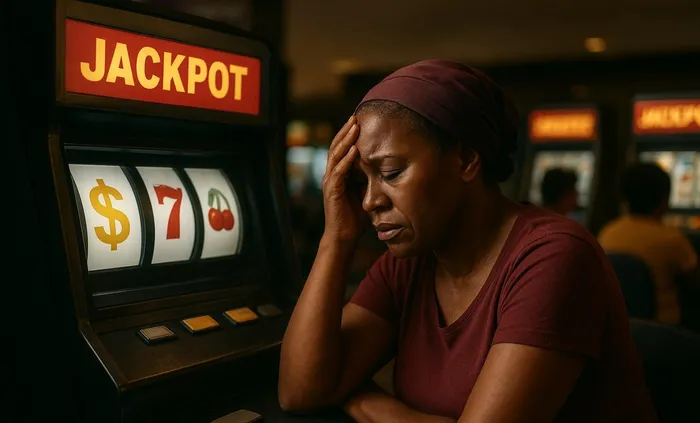
The money won will never make up for all the losses.
Image: Gerry Cupido / ChatGPT
How you get hooked
One Cape Town woman, now 63, recalls how her addiction began at 38.
“A friend of mine said to me, ‘Come, just see what’s happening here,’ and so I went and played,” she says. Her first visit was intoxicating. She turned R100 into R1,000, and her next two visits brought in R2,000 and R2,500.
“That’s how you get hooked,” she explains. “By winning the jackpot at the beginning.”
Those early wins created a false sense of control. Even as her losses piled up, she kept thinking, “Well, I won the other day. I’ll win again.”
Her biggest win was R40,000, but she now understands the illusion. “When you win R40,000, how much money have you already spent on the days you didn’t win anything?” she asks.
Loneliness also played a major role. “I found comfort in the machines,” she says. “I was lonely, I was divorced. I used to go to the casino a lot.”
Eventually, the stress became too much. “It’s not relaxing anymore. Then you stress,” she says.
She stopped gambling and now warns others: “It’s not worth it. Stress gives you high blood pressure, and it makes you sick. That’s why I stopped. My advice is just don’t start. Please, ladies, it’s not worth it. You never, ever get your money back.”
“This machine keeps chowing my money”
At a busy KwaZulu-Natal casino, a woman in her late 60s told IOL she had already lost R3,000 by lunchtime. By 2 pm, her losses had climbed past R5,000.
“I am so angry. I keep playing and hoping that I’ll win, but I haven’t yet,” she said. “I arrived with R3,000 this morning and thought it would be enough, but this machine keeps chowing my money.”
She walked away only long enough to fetch another R2,000. “I will win this time,” she insisted, moments before losing again.
Women will keep playing and hoping that they'll win.
Image: Hailey Smith / Pexels
Why women gamble
Louise Swart, a recovery coach at Cape Addiction Recovery Specialists, says gambling addiction in women goes far deeper than the desire to win money.
“Gambling addiction is part of a process addiction,” she says, comparing it with other compulsive behaviours.
Many assume women are less likely to develop this addiction. Swart disagrees. “That’s the furthest from the truth.”
Most cases she sees are rooted in trauma or loneliness. Gambling becomes an escape, even through something as simple as a mobile game.
“Candy Crush has opened up this whole avenue to gambling addiction for people, and they don’t even know it,” she says.
For many women, the lure is emotional. “For that split second, there’s worth. It’s like, ‘I’ve done something, I’ve achieved something.’ It’s this false sense of belonging.”
The machine becomes a companion. “It doesn’t judge them. It doesn’t tell them they’re lonely. It doesn’t tell them they have a problem,” she says.
The outcome is always the same. “You never make your money back. You just never do.”
Swart recalls a woman who finally won a large amount, only for her husband to say, “Finally, you made back all the money you’ve wasted.” That comment captures how gamblers cling to the illusion of control created by the first win.
Swart notes that gambling addiction often shifts forms. If money is limited, people may turn to other compulsive behaviours. “It never stops, it never levels out, it always goes deeper.”
She adds that the brains of gambling addicts and heroin addicts show similar patterns of damage. “Women now make up between 30 and 50 per cent of people seeking treatment for gambling problems,” she says, though shame and silence keep many cases hidden.
The high cost of the win
What begins as entertainment or distraction can quickly turn into a lonely, isolating addiction. For many women, gambling is less about winning money and more about coping with emotional pain or filling a void.
But the cost is always higher than the winnings. No matter how bright the lights or tempting the jackpots, the house always wins, and the emotional toll on women is often the heaviest burden of all.
For help to quit gambling, call the The South African Responsible Gambling Foundation on its toll free counselling line, 0800 006 008 Or WhatsApp/SMS HELP To 076 675 0710 or email to helpline@responsiblegambling.org.za