Who controls the world's oil? The top 10 nations with the largest reserves
These are the countries with the largest oil reserves.
Image: Pexels
While ranking oil reserves usually seem like a matter of geology and something only people in certain fields would be interested in, recent events have turned this list into a geopolitical roadmap.
After the US' move to capture Venezuela's president Nicolas Maduro and his wife Cilia Flores and the Coast Guard's seizure of the tanker Centuries, the world’s focus has snapped back to the massive disparity in global resources.
As the US make moves that many argue breaches international law, understanding who actually holds the keys to the world's remaining oil is more critical than ever. Here are the top 10 countries with the largest proven oil reserves.
1. Venezuela: Approximately 303 billion barrels
Venezuela sits on the largest pile of confirmed oil on the planet, holding more than 300 billion barrels. However, this wealth is currently the centre of a geopolitical storm.
The country's massive, largely untapped reserves have been thrust into the spotlight after recent US interventions, including the ouster of Maduro and the seizure of crude oil tankers directed to US ports. Despite holding the most oil, Venezuela struggles economically. Unlike the "easy oil" in the Middle East, Venezuelan crude is largely offshore, deep underground, and dense. Extracting it with current technology is often too expensive to be profitable, leaving the nation in an economic paradox: holding the world's biggest trust fund but unable to access the cash.
2. Saudi Arabia: Approximately 267 billion barrels
Saudi Arabia holds the second-largest reserves but enjoys a stronger economy than Venezuela. The difference lies in accessibility. Unlike Venezuela, Saudi oil reserves are located on land and close to the surface, making extraction more cost-effective.
3. Iran: 208–209 billion barrels
Rounding out the top three is Iran, possessing over 200 billion barrels of proven reserves. Like Venezuela, Iran represents a massive portion of the world's energy future that is currently constrained by Western government sanctions, which have tightened supply forecasts through 2026.
4. Canada: 163 billion barrels (Estimate varies)
Canada’s ranking depends entirely on how you count. If you include unconventional sources like oil sands, Canada ranks 4th globally with 163 billion barrels. However, some data sets exclude these heavier oils, which causes Canada's proven reserves count to plummet to just 4.3 billion barrels, dropping it out of the top 10 entirely.
5. Iraq: 145 billion barrels
Despite decades of conflict, Iraq remains a critical player, holding 145 billion barrels of confirmed reserves.
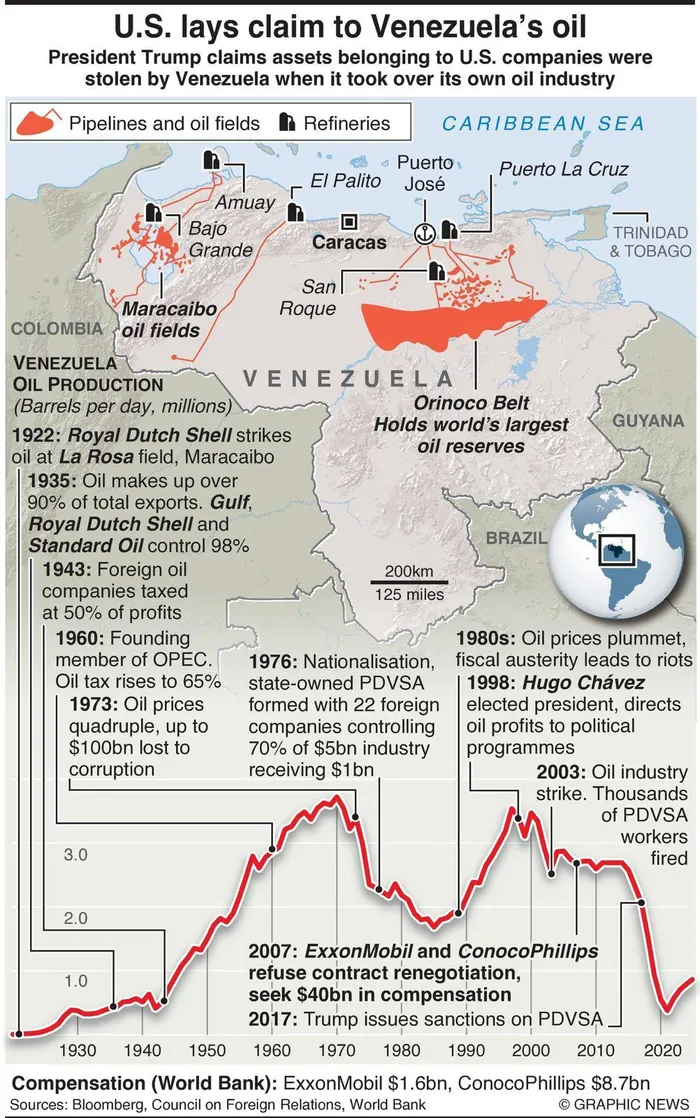
President Trump claims assets belonging to US companies were stolen by Venezuela when it nationalised its oil industry in 1976, and a renegotiation of contracts in 2007.
Image: Graphic News
6. United Arab Emirates (UAE): 113 billion barrels
The UAE secures the sixth spot with significant reserves that confirm the Middle East's dominance in the energy sector.
7. Kuwait: 101.5 billion barrels
A small nation with massive wealth, Kuwait holds over 100 billion barrels, contributing to OPEC's supremacy over global supply.
8. Russia: 80 billion barrels
While often discussed for its natural gas, Russia remains a top-tier oil giant with 80 billion barrels of proven reserves. Along with Canada, it is one of the few non-OPEC nations with significant capacity to influence global production.
9. United States: 45–74.4 billion barrels
The United States represents a unique paradox in the oil market, because of the issue of production vs. reserves. Due to tech-driven shale booms, the US is currently the world’s top oil producer, pumping record volumes of around 13 million barrels per day.
However, it ranks only 9th in reserves, holding between 45 and 74.4 billion barrels.
It's also worth noting that the US is the world's largest consumer of oil and burns through energy faster than its limited reserves can sustain long-term. This necessitates imports from other nations and drives the aggressive strategic interest in neighbours like Venezuela, whose reserves make the US reserves look small in comparison.
10. Libya: 48.4 billion barrels
Holding the largest oil reserves in Africa, Libya rounds out the top 10 with nearly 50 billion barrels, though its output is frequently impacted by internal instability.
While technology has allowed countries like the US to lead in short-term production, the long-term "keys to the kingdom" are still held by OPEC members, who control over 60% of the world's confirmed reserves (approx. 1.7 trillion barrels). As the US looks to secure its future supply, eyes remain fixed on the massive, difficult-to-reach wealth buried beneath Venezuela.
IOL