Trump's return complicates US-Europe relations with a shift in strategy
DAMAGE CONTROL

A French Air Force Dassault Rafale B fighter jet is deployed in Polish airspace during an exercise as part of "Eastern Sentry". The US has indicated it wants Europe to take over the majority of NATO’s conventional defence capabilities, from intelligence to missiles, by 2027.
Image: French Army / AFP
The Polish leader struck an uncertain note. “Dear American friends, Europe is your closest ally, not your problem,” Prime Minister Donald Tusk posted on social media Saturday. “And we have common enemies. At least that’s how it has been in the last 80 years. We need to stick to this, this is the only reasonable strategy of our common security. Unless something has changed.”
The “something” in Tusk’s formulation, looming across the Atlantic and casting a shadow across European capitals, is the spectre of President Donald Trump. The return of his “America First” brand of politics this year has already provoked rounds of continental hand-wringing over the future of U.S.-Europe relations and the geopolitical perils that Europeans must face alone. Over golf games and White House confabs, a host of European leaders have wooed Trump, flattering and praising him while attempting to disabuse him of his conspicuous affections for the Kremlin and contempt for the European project.
Those entreaties have not quite worked and more damage control seems needed. The late Thursday release of the White House’s National Security Strategy, a document sketching the president’s foreign policy priorities and their ideological underpinnings, landed like a grenade in Brussels. Instead of focusing on the geopolitical challenge of Russia and China (as Trump’s first term NSS did), it took aim at Europe itself, warning against the “civilisational erasure” of the continent thanks to unfettered migration and a feckless liberal establishment.
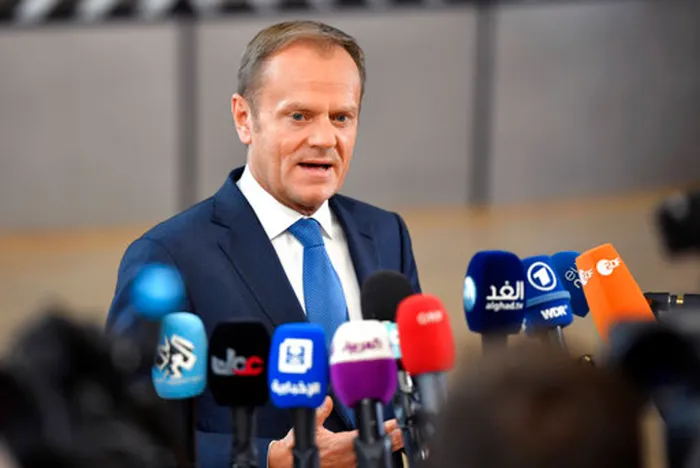
Polish Prime Minister Donald Tusk has appealed to Americans, saying Europe is their closest ally, not their problem.
Image: Martin Meissner/AP
The document scoffed at the “unrealistic expectations” of European officials backing Ukraine in its fight for survival against Russia and the “unstable minority governments” - a jab at embattled European centrists - that they represent. It frames the Trump administration’s broader view as one turning away from an era of global domination to an approach tethered more narrowly around U.S. interests. “The days of the United States propping up the entire world order like Atlas are over,” the strategy says.
Little of this is surprising, but the NSS underscored the depth of ideological vehemence within the White House. Gérard Araud, a former diplomat who served as France’s ambassador to the United States as well as the United Nations, responded in a social media post that “the stunning section on Europe reads like a far-right pamphlet”.
The NSS cheers the “growing influence of patriotic European parties” and supports “cultivating resistance to Europe’s current trajectory within European nations” - that is, it backs the European far right and wants to undermine the workings of the European Union. “The only part of the world where the new [U.S.] security strategy sees any threat to democracy seems to be Europe,” former Swedish prime minister Carl Bildt wrote on X. “Bizarre.”

Ukraine President Volodymyr Zelenskyy meets European Commission President Ursula von der Leyen. America has scoffed at the “unrealistic expectations” of European officials backing Ukraine in its fight for survival against Russia.
Image: Supplied
Separately, Reuters reported that U.S. officials had communicated to European counterparts that they want “Europe to take over the majority of NATO’s conventional defence capabilities, from intelligence to missiles, by 2027,” an implicit withdrawal of U.S. commitments that could have seismic implications for the military alliance. “If true, this is earth-shattering stuff,” observed Politico’s Nicholas Vinocur. “The shortness of the timeline is staggering. E.U. populations are not prepared for what this means - illusions crumbling, brutal choices ahead.”
By the weekend, a chorus of Trump allies showed little sign of conciliation. The news that the E.U. had fined X $140 million for its apparent violations of the bloc’s regulations was described by Secretary of State Marco Rubio as “an attack on all American tech platforms and the American people by foreign governments.” Tech mogul and X owner Elon Musk was more scathing: “The E.U. should be abolished and sovereignty returned to individual countries, so that governments can better represent their people,” he wrote.
Top Kremlin officials amplified these calls, cynically supporting the posturing over free speech by Vice President JD Vance and Musk, whose website is blocked in Russia. Dmitry Peskov, Russian President Vladimir Putin’s top spokesman, said Trump’s NSS “corresponds in many ways to our own vision.” Such rhetoric only deepens the conviction among some Europeans - including, according to an apparent leaked transcript of a phone call, French President Emmanuel Macron and German Chancellor Friedrich Merz - that the Trump administration is prepared to jettison Ukrainian and European interests in favor of a swift political settlement with Russia.
“Unity between Americans and Europeans on the Ukrainian issue is essential,” Macron told reporters during a trip to China on Friday. “And I say it again and again, we need to work together.”
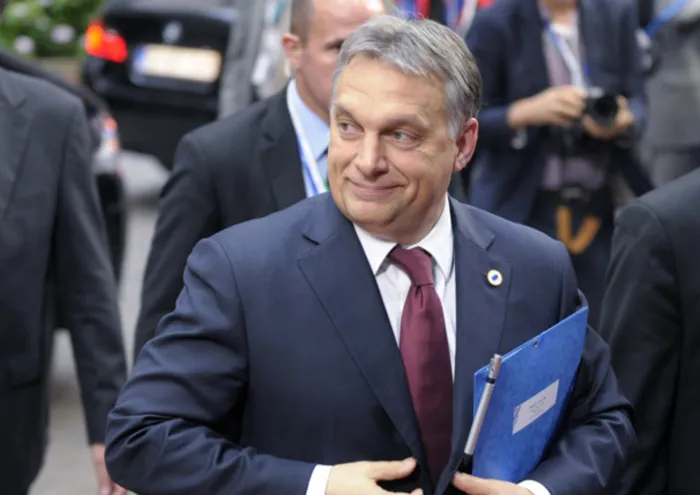
US President Donald Trump has forged a relationship with Hungarian Prime Minister Viktor Orban, above, a friend of Russian President Vladimir Putin.
Image: Laurent Dubrule / Reuters
But the Trump administration appears more interested in boosting other forces within Europe, including far-right factions with neofascist origins that were once considered beyond the pale in Western politics. Trump has embraced Hungarian Prime Minister Viktor Orban, the illiberal black sheep of the European Union and a friend of Putin. And he has echoed far-right calls for “remigration” and the deportation of Muslim or other non-White migrants in Western societies.
Trump appears to be promoting what the scholars Tara Varma and Sophia Besch coined earlier this year as “revisionist transatlanticism,” where an ultranationalist White House and European nativists “could work to renegotiate the values and interests that unify the United States and Europe, and, in the process, dismantle the European project.”
The new NSS “is targeting Europe in a very deliberate manner,” Varma, a visiting fellow at the Brookings Institution, told me. “Despite announcing a form of retreat or isolationism, it actually focuses on the continent and the necessity for it to be fully aligned with the ideological goals” of Trump’s second term.
These gestures, which dovetail with Trump’s broader record of bullying and coercion since returning to the White House, might backfire. “Finally, America is now saying that key allies are in fact its greatest enemy,” wrote Johns Hopkins University political scientist Henry Farrell. “That gives those allies strong incentives to reduce their dependence on American power and technological and economic platforms, building closer connections among themselves and perhaps with others. All this is likely to the benefit of those who’d like to see America taken down a peg or three.”
Washington Post