Sudan's oil-rich south faces fiercest fighting yet: what we know
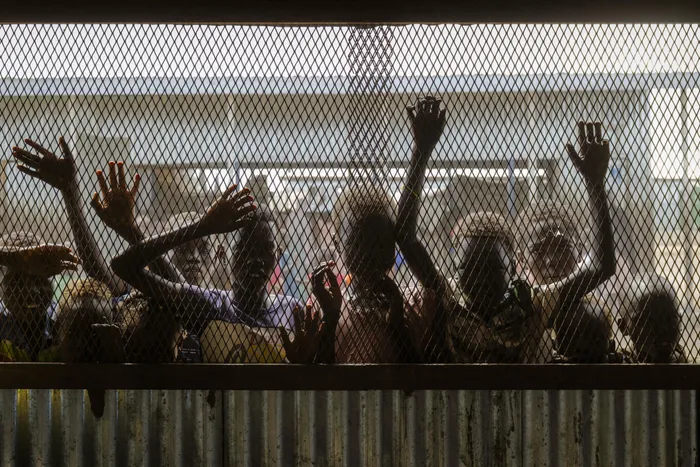
Children gather at the fenced window of a safe-space classroom managed by War Child Holland at the Renk Transit Center in Renk, South Sudan, on November 17, 2025. South Sudan’s Renk Transit Center, built for 3,000, now shelters over 12,000 refugees, returnees, and deportees fleeing the Sudan war that has displaced more than 1 million people since 2023, with thousands living in makeshift tents and straining limited food, water, and medical resources.
Image: Photo by RIAN COPE / AFP
Emboldened by their capture of the Darfur regional hub of El-Fasher, Sudan's paramilitary Rapid Support Forces have set their sights on oil- and gold-rich Kordofan, waging intense battles with the army there in recent weeks.
The RSF -- at war with the military since April 2023 -- have deployed fighters, drones and allied militias to the fertile region, where analysts say they seek to punch through the military's defences around central Sudan, paving the way to recapturing Khartoum.
Communications blackouts and conflicting accounts from both sides make independent verification extremely difficult, but local officials, aid groups and the UN have reported escalating drone strikes, heavy shelling and mass displacement, warning of possible atrocities akin to those seen in El-Fasher.
Here is what we know about Kordofan, a region that has become a major battleground in a conflict that has killed tens of thousands of people and displaced nearly 12 million.
Why Kordofan matters
Kordofan -- a vast agricultural region split into three states -- lies between RSF-controlled Darfur in the west and army-held areas in Sudan's north, east and centre.
Its position is important for maintaining supply lines and moving troops.
The army hopes to hold onto key cities to slow the RSF's post-El-Fasher momentum, while the paramilitary forces are seeking to open up a route to encircling central Sudan and squeezing remaining army strongholds.
Economically, Kordofan is vital: major agricultural zones produce gum arabic, sesame, sorghum, millet and groundnuts, alongside extensive livestock farming.
It also hosts major oil facilities, including Heglig and Balila, both of which have come under repeated attack.
Balila was forced to shut down after being captured by the RSF early in the war, while Heglig remained operational until Monday, when it was reportedly seized by the RSF, according to an engineer at the facility.
Sudan's energy and petroleum ministry did not immediately respond to a request for comment on the report.
Kordofan also sits atop some of Sudan's richest gold deposits, which have become a fiercely contested source of revenue.
These resources have long underpinned Sudan's political economy and now sustain the war effort.
The region also houses entrenched army divisions, whose capture would give the RSF access to weapons, armoured units and transport networks.
Who is fighting
Led by Abdel Fattah al-Burhan, the army relies on Chinese tanks, Soviet-era aircraft, and drones supplied by Turkey and Iran, according to Stockholm-based security consultancy African Security Analysis.
The RSF, commanded by former army ally turned rival Mohamed Hamdan Daglo, is a paramilitary force descended from the Janjaweed militias that suppressed Darfur rebellions under ousted dictator Omar al-Bashir.
The UAE has been accused of supplying the RSF with weapons, mercenaries and fuel, which it denies.
Earlier this year, the RSF allied with Abdel Aziz al-Hilu's Sudan People's Liberation Movement-North (SPLM-N), extending its control and local legitimacy in the Nuba Mountains and parts of Blue Nile state bordering Ethiopia, long held by the rebel faction.
Where the fighting is
Fighting is focused on cities housing army barracks, including El-Obeid, Kadugli, Dilling and Babanusa.
El-Obeid, North Kordofan state's capital, has become a primary RSF target following El-Fasher's fall.
The partially encircled city lies on a key Darfur-Khartoum route and hosts a military logistics airport.
It has faced repeated drone and artillery strikes. Nearby Bara was recently recaptured by the army after a brief RSF occupation.
In South Kordofan, the army has launched strikes in and around Kauda, the SPLM-N stronghold, while Kadugli and Dilling remain under siege, trapping thousands without food or medicine.
In West Kordofan, the RSF has claimed to have taken Babanusa, giving them full control of the state, though the army denies this.
Humanitarian toll
The UN has confirmed famine in Kadugli, and has warned that Dilling was experiencing similar conditions, though a lack of access prevents a formal declaration. Famine was declared in parts of the Nuba Mountains last year.
On Thursday, a paramilitary drone attack on a kindergarten and a hospital in South Kordofan's Kalogi town killed dozens of people, including children, a local official told AFP.
A day earlier, local rescuers reported at least six deaths after an army drone strike on Nama town in West Kordofan.
On November 29, an army strike on Kauda killed 45 people, while an RSF attack on November 3 hit a funeral tent in El-Obeid, killing 45, mostly women, according to the UN.
UN figures report that 45,000 people have fled Kordofan in the past month.
AFP