This is why the US is threatening to attack Venezuela
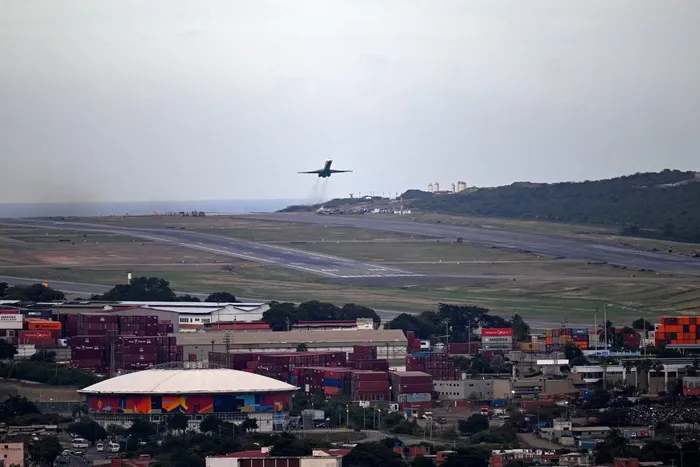
US President Donald Trump sharply escalated his threats against Venezuela on Saturday with an ominous warning that the country's airspace should be considered 'closed,' raising fears of imminent military action.
Image: Frederico Parra/AFP
Tensions between Washington, United States and Caracas, Venezuela, have reached a new high this week after United States President Donald Trump declared that Venezuelan airspace had been “closed” on Saturday, without providing further details.
This announcement follows months of a massive US military build-up in the Southern Caribbean.
Venezuela has condemned the action as a "colonialist threat” and an “extravagant, illegal and unjustified aggression against the Venezuelan people”.
The escalation comes as the Trump administration continues to deploy military assets, including the world’s largest aircraft carrier, USS Gerald R Ford, along with warships, thousands of troops, and F-35 stealth jets, to the Caribbean region.
Since returning to power in January, Trump has aggressively increased pressure on President Nicolás Maduro, including doubling the reward for Maduro’s arrest to $50 million and designating him a “global terrorist leader”.
Why is the US threatening to attack Venezuela?
Venezuela is no stranger to attacks, or threats of attacks, from the US. The US has launched a series of strikes against alleged drug boats in international waters since early September. The administration claims the operations are part of a push to combat drug trafficking, which Trump claims is responsible for American deaths.
These maritime strikes have resulted in scores of casualties. At least 83 people have been killed in nearly two dozen attacks on suspected vessels. The most recent reported strike on a suspected drug boat took place on September 2.
Trump has explicitly indicated that there will be further military escalation. Last Thursday, he stated that land strikes inside Venezuela could come imminently and at the weekend, he issued the airspace warning to “Airlines, Pilots, Drug Dealers, and Human Traffickers”.
However, despite the escalating military threat, Trump indicated that diplomatic communication is still possible. On November 25, while on board Air Force One, Trump addressed reporters concerning a potential talk with Maduro, a leader he has called the head of a "foreign terrorist organisation"
“I might talk to him. We’ll see. But we’re discussing that with the different staff. We might talk,” Trump told reporters. When asked about speaking to Maduro, he replied: “If we can save lives, we can do things the easy way, that’s fine. And if we have to do it the hard way, that’s fine, too.”
What do analysts say about the conflict?
While the Trump administration officially links its policy to tackling illegal drugs and human trafficking, policy analysts in the US point to deeper strategic motives.
Analysts argue that the US aggressive stance is rooted in Venezuela's possession of the world’s largest proven oil reserves and Trump's seeking to establish US supremacy in the Western Hemisphere.
According to Republican strategists, the ultimate objective is forcing Maduro to exit, a move which could be difficult. US also seeks to ensure Venezuela aligns with US strategic preferences rather than with countries like China, Russia, or Iran.
However, the administration’s focus on Venezuela as a key drug threat is contradicted by data, which indicates that the fatal fentanyl crisis is overwhelmingly fueled by Mexican cartels, with fentanyl entering the US via the southwest land border and not the Caribbean maritime routes currently targeted by the US Navy.
The ongoing military action has drawn internal criticism in Washington, where critics argue the deadly boat strikes amount to “extrajudicial killing” and violate international law and the US Constitution.
The US Congress has ordered an inquiry into the incidents. The Senate Armed Services Committee is specifically investigating allegations of “kill orders” issued by Defense Secretary Pete Hegseth during a military strike. Hegseth has rejected the allegations as "fabricated, inflammatory, and derogatory".
Trump’s 2023 remarks on oil
The current push for regime change aligns with remarks President Trump made in June 2023, where he linked Venezuela's instability to its vast oil reserves and criticised the then-administration for purchasing oil from Caracas.
“Remember, during the campaign I said we're gonna end up like a big scale version of Venezuela. Now we're buying oil from Venezuela. When I left Venezuela was ready to collapse, we would have taken it over, we would have gotten all that oil. It would have been right next door.
"But now we're buying oil from Venezuela. So we're making a dictator very rich. Can you believe it? Nobody can believe it. You know their oil is garbage; it's hot, the worst you can get is like tar, and to refine it, you need special plants. We have liquid gold, the best most beautiful thing you can get. It's better than gold, right under our feet. We will have more than Saudi Arabia, more than Russia. We are gonna pay off debt, reduce taxes and we are going to make so much money.
"With Venezuela, they put their oil, refine it in Houston, so all of the pollutants go right up in the air. We don't want to take oil because we want to watch the environment, but we will take the worst tar in the world, burn the crap out of it, create oil and watch it go into our atmosphere, and the environmentalists have no problem with it, so we lose economically and from an environmental point of view. We take it from Venezuela and we also make the country strong again, the head of the country is a dictator. "
International and domestic backlash
The military escalation has garnered global condemnation.
The French Foreign Minister stated the strikes “violate international law,” leading to a sharp rebuke from US State Secretary Marco Rubio.
Left-wing Colombian President Gustavo Petro described Trump as a “barbarian” and called the military build-up “undoubtedly an aggression against Latin America,” subsequently severing security cooperation with the US Brazil’s President Lula da Silva warned against foreign leaders making assumptions about Venezuela.
Russian Foreign Minister Sergey Lavrov condemned the US strikes as “unacceptable,” characteristic of “lawless countries”.
Chinese President Xi Jinping reaffirmed the two nations as “intimate friends,” strongly opposing external meddling.
On US soil, the focus on foreign conflicts has caused division within the Make America Great Again (MAGA) base, which campaigned on avoiding “forever wars”. Representative Marjorie Taylor Greene publicly criticised the administration’s focus on foreign conflicts over domestic economic issues.
IOL